

Three Different Americas
Three New York Times editorials for the 250th anniversary, one absent voice, and a country that no longer agrees on what it is celebrating.

The United States turned two hundred and fifty with a presidential rally on the Mall and, in the pages of its most influential newspaper, three attempts to say what was actually celebrating a birthday. A Black columnist reconstructed how the excluded built the Declaration’s meaning; a Catholic conservative staged the unifying address no politician would deliver; the editorial board handed the next fifty years a list of open questions it preferred not to answer. Three voices, one newsroom, one occasion – and three definitions of the country that coincide in nothing. Read together, they say more about America than any of them meant to.
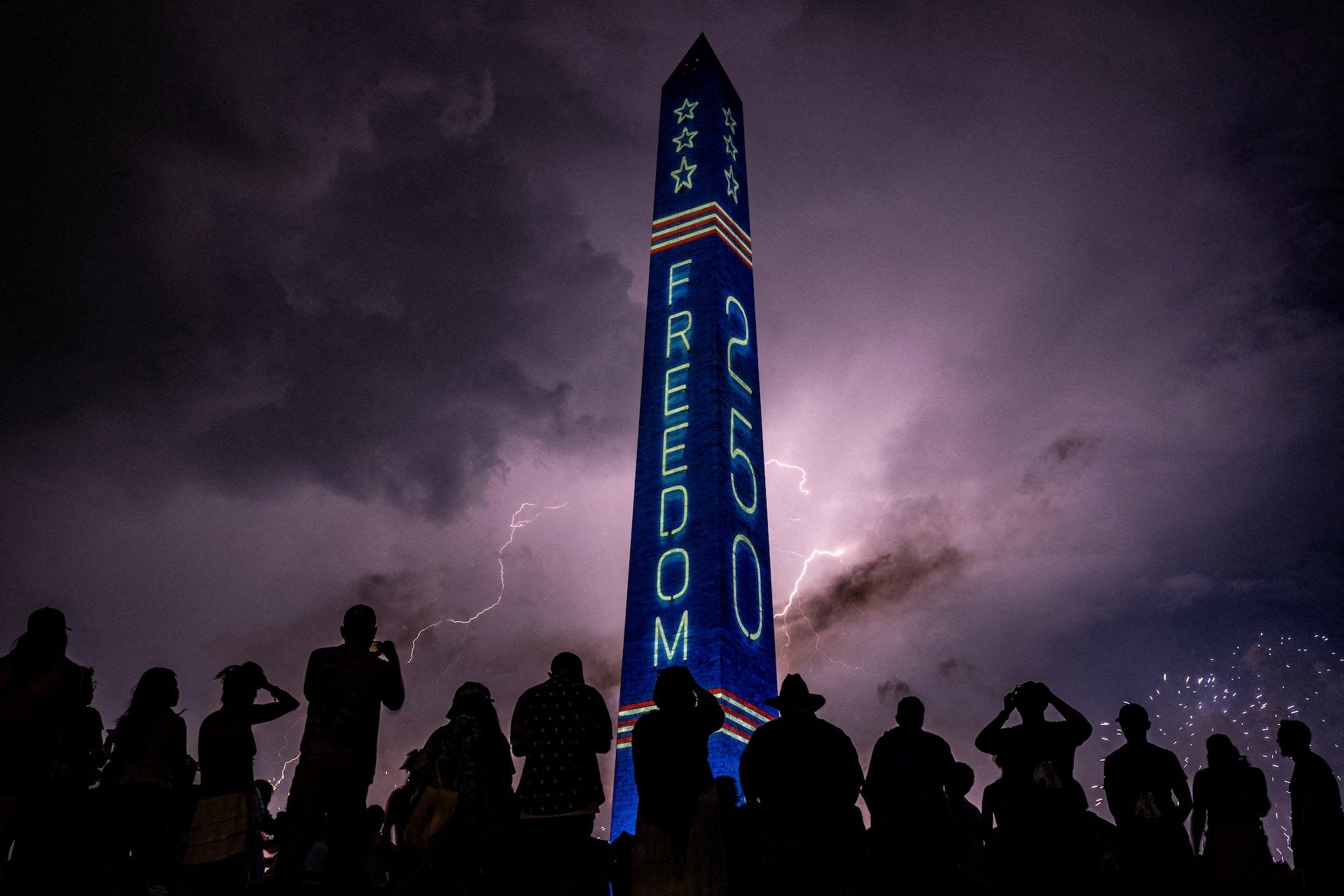
The birthday question
While Washington was dismantling the stage of the presidential rally, readers of the New York Times were receiving a question dressed up as a celebration. The world’s most influential liberal newspaper entrusted the 250th anniversary of the Declaration of Independence to three voices: columnist Jamelle Bouie, who reconstructed the history of the five words about equality; Ross Douthat, who staged the unifying address no politician would deliver; and the editorial board, which handed the next fifty years a list of open questions. Three pieces published within hours of each other, conceived for the same occasion, written inside the same newsroom. Read in sequence, they compose an involuntary document: three definitions of America that share almost nothing, except the absence they all circle around.
For Bouie, America is a text, whose meaning was built from below by those it excluded. For Douthat, it is a frontier, a perpetual motion of new beginnings. For the board, it is a wager, a procedural habit to be renewed by every generation. The three metaphors lead to different and in some respects opposite political conclusions, and the fact that they coexist in the same newspaper, on the same day, measures the state of the American debate better than any poll. On July 4th, in Americana, my Italian-language section, I traced the contest over ownership of the Declaration from Frederick Douglass to the rally on the Mall. The three Times editorials show that the contest now runs through the very camp of those who would defend the promise.
Bouie’s text
Bouie’s piece starts from a distinction that celebratory rhetoric usually erases. The Declaration Jefferson wrote in 1776 contained a narrower claim of equality than American civic memory recalls: in the document’s Lockean framework, men were born equal in the state of nature, before government, in the sense that no one held authority over others by right of birth or divine gift. It was an argument about the legitimacy of political power, built to justify revolution against a king; the passage from natural equality to political and social equality remained outside the perimeter, and for most Patriot leaders men could be born equal and remain subordinate. Bouie leans on the historian Pauline Maier to recall that this was the orthodoxy of the age, absorbed through sermons and newspapers before any treatise.
The most effective part of the piece reconstructs who turned that thought experiment into a claim for the present. It was Black Americans, free and enslaved, who read the Declaration as an enforceable promise, and they began doing so before the document was even signed: the petitions Bouie assembles speak the Patriots’ language with a fluency that turns the charge of anachronism on its head. In 1774 an enslaved man in Connecticut wrote to the Sons of Liberty that liberty, founded on the law of nature, is as necessary to the happiness of an African as to that of an Englishman. In 1791 the mathematician Benjamin Banneker quoted Jefferson’s own words back to him, accusing him of holding his brethren in captivity while professing the equality of mankind. From there the line runs through the abolitionists, through Douglass, through Lincoln consecrating the excluded’s reading as national identity at Gettysburg, down to the Fourteenth Amendment writing it into the Constitution. Bouie’s conclusion: the meaning of the Declaration flows less from those who signed it than from those who heard it and claimed it as the standard of their own freedom.
The argument converges with what I wrote on July 4th, and adds a piece mine did not have: the construction of meaning began in real time, within the revolutionary generation, at the hands of people who were “men of their time” just as much as Jefferson. It is the most politically sharpened point of the essay, because it dismantles the customary absolution of the founders with archival material rather than retroactive moral categories. Bouie names the contemporary target openly: the movement that defines citizenship by blood and heritage and treats Black history as material to be removed from school curricula. In his reading, the assault on African American studies serves to obscure the fact that the claim of equality is as old as the Republic.
Douthat’s frontier
Douthat chose the most theatrical form of the three: an imaginary presidential address, delivered on video in his good suit, offering the national unity no real politician would provide. The autobiographical frame is effective, with the minivan journey across the continent and the discovery that his great-great-grandfather had built the Kalispell hotel his family had driven past unawares. From there the Catholic columnist derives his definition: America as the possibility of starting over, not once for the immigrant who takes the oath, but generation after generation, and the present crisis as a crisis of stasis, of a country told the frontier is closed and all that remains is administering what exists.
The remedy Douthat proposes deserves close reading, because this is where the piece reveals more than it intends. The new heroic age his address invokes includes the space frontier, with the Moon and Mars, and so far we are in the classic repertoire. Then come the territorial frontiers: if the people of Alberta, Cuba or Australia wanted to become Americans, perhaps they should be able to; taking Greenland by force is madness, he writes, but seeking it in a fair exchange is as American as Alaska. There follows the invocation of a new age of monuments, with statues of Lewis and Clark rising over the Missouri like the kings of Gondor, and the wealth of Tolkien-reading technologists summoned to beautify the cities as the industrialists’ wealth once did.
Readers of my Linea di faglia essay on the trajectory of Trumpian expansionism will recognize the landscape. Douthat writes in explicit distancing from the president, and the distinction between forced annexation and consensual purchase is, for him, the line between madness and American tradition; the point is that the agenda stays the same, changed in register. Greenland bought rather than threatened, gigantic monuments entrusted to billionaires rather than to government, manifest destiny in lyrical rather than Truth Social form. The unifying address of intellectual conservatism, written to mark its difference from Trumpism, shares Trumpism’s map: territorial expansion, monumentality, the refusal of stasis as a betrayal of the national essence. For the European reader this is the datum to record, because it locates the American territorial appetite beyond the biography of one president and inside a cultural current that will outlive him.
Every analysis takes time, reading, and verification. If you find this work valuable, a donation helps keep it independent. It is the best way to support analysis like this. Thank you.
The board’s wager
The unsigned editorial is the most institutional of the three and the most reticent. Trump is barely named; in his place, five questions for the next fifty years, introduced by the line attributed to Franklin about the republic, “if you can keep it”. The first asks whether a self-governing people still shares a common reality, with trust eroding in the institutions that settle facts and artificial intelligence able to fabricate convincing lies in seconds. The second asks whether Americans can still bear to lose, that is, whether the defeated side will accept defeat, surrender power and live to argue another day. The third concerns the material promise, that those who work can rise, and concedes that the last fifty years have been dismaying. The fourth reformulates the oldest question, whether the most pluralist nation in history can remain one people. The fifth looks to the sacrifices that climate and debt demand today for the benefit of those who have not yet voted.
The grid is useful precisely for what it refuses to say. Each of the five questions describes, in hypothetical form and addressed to the future, a damage already underway and already attributable: shared reality has cracked partly because the sitting president treats every unwelcome fact as false; the capacity to lose was tested on January 6th, 2021, and we know the outcome; pluralism by assent to an idea is exactly what the current politics of citizenship contests, as the Supreme Court has just recalled in Trump v. Barbara, striking down the attempt to end birthright citizenship by executive order. The board writes as if its questions were evenly distributed between the two camps, and this grammatical equidistance, understandable in an anniversary editorial, produces a document that will age well or badly depending on how things turn out. Its usefulness lies elsewhere: the five questions are the grid through which to reread the coming years, and the second, the one about defeat, is the question on which all the others depend.
The question and the promise
What remains to be said is what the three pieces share, and it is an absence. Douthat declares it in his title, the unifying address we will not get. Bouie names the movement besieging his Declaration without granting it the name of its leader. The board speaks in abstractions anyone can fill. In none of the three does the president of the United States appear as the voice of the nation on its birthday; in all three he is the problem the text circles, explicitly or by omission. Historical comparison makes the anomaly visible: in 1926 the sesquicentennial address was delivered by the president, and Coolidge disappeared behind the document; in 1976 it was delivered by Ford, who crossed three states to serve the rite. In 2026 the president’s address did take place, on the Mall, and the three attempts to say what was turning 250 appeared in a newspaper, each on its own.
The contest over the meaning of Independence Day has a long history, and on July 4th I followed its main thread: the excluded reclaiming the document against the nation that betrays it, from Douglass to Susan B. Anthony to King. That contest set those inside the promise against those kept out of it, and it presupposed a basic agreement on what the promise contained. The three editorials of the 250th document a different phase. The text, the frontier and the wager sketch three countries with three pasts, three enemies and three different tasks, and none of the three Americas recognizes the other two as interlocutors: Bouie does not argue with Douthat, Douthat does not answer Bouie, the board glides over both. Two hundred and fifty years after the signing, the open question has stopped being whether America will keep its promise. It has become which promise, among the three in circulation, the country will decide it has kept.