
Room 9582
The behavior of power.

To announce the investigation he had chased for years, Kash Patel chose Joe Rogan’s podcast over a court filing. In a black hoodie, cigar lit, in June 2025 he described finding a secret room inside FBI headquarters, full of documents a cabal of officials had supposedly hidden from the world. A conspiracy ran across several administrations to bring down Donald Trump, he said, and the proof sat inside the burn bags, the striped paper sacks used to hold documents marked for destruction. Inside the Justice Department the inquiry earned an ironic name, the grand conspiracy.
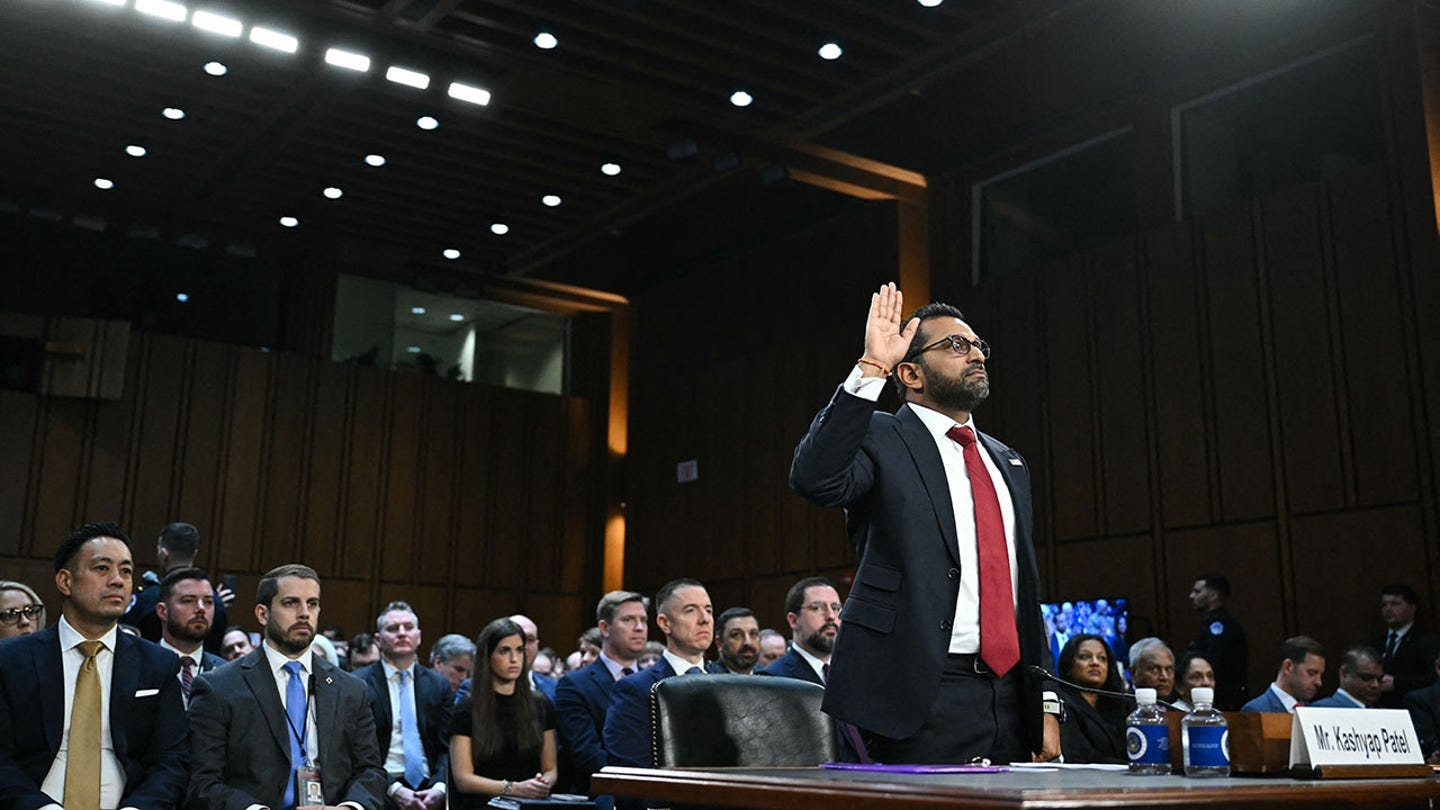
The room was real. It carried the number 9582 and served as a SCIF, a sealed space for classified material. The bags were real too, five of them, holding records on the Mar-a-Lago search, January 6, the Crossfire Hurricane investigation. When career prosecutors opened them they found archived paper and no trace of a conspiracy’s hand. The simpler explanation, that a senior official pushed out by the administration had cleared his office after years on the job, interested no one. From that point the inquiry changed its object. It stopped looking for evidence of a plot and began looking for a prosecutor willing to sign an indictment on the thin material already in hand. Barrett’s book, The Department of Revenge, and the New York Times account follow that second hunt step by step.
The prosecutor who signs
The hunt for a willing signature did not begin with Room 9582. Early in 2025, in the case against New York mayor Eric Adams, the department told Manhattan prosecutors to drop a charge they considered sound. One of them, Hagan Scotten, a former clerk to Chief Justice John Roberts, refused in a letter that circulated widely, predicting the administration would eventually find someone foolish or cowardly enough to file the motion. He had described the method in advance. When the apparatus fails to produce the desired outcome, you go looking for the person who will.
The same method fell on Todd Gilbert. Sworn in as interim U.S. attorney for the Western District of Virginia in mid-July, he was handed Patel’s order to pursue the grand conspiracy. His district’s jurisdiction, he and his prosecutors concluded, covered only one of Patel’s three lines of inquiry; the strand on Comey’s congressional testimony went to the Eastern District of Virginia, the one on former CIA director John Brennan to Philadelphia. Gilbert refused to convene a grand jury without a sufficient factual basis. In mid-August, after a senior White House official told Virginia’s governor that Gilbert would be removed and should not be protected, he was gone, thirty-seven days into the job. His office left behind a declination memo, the formal analysis a prosecutor writes to explain a decision not to charge, setting out why none of the accusations held. The senior FBI agent on the case endorsed it.
The pressure moved to Alexandria. Erik Siebert inherited the Comey file along with a mortgage investigation into Letitia James, the New York attorney general who had won the first round of her civil suit against Trump. Siebert resisted too. In September 2025 Trump removed him with a Truth Social message written as a private note to Attorney General Pam Bondi, complaining that Comey, James and Senator Adam Schiff had still not been charged. In his place came Lindsey Halligan, a former White House aide and insurance lawyer with no experience as a prosecutor, who three days after being sworn in secured Comey’s indictment, scraping together fourteen of twenty-three grand jurors.
This is where Barrett plants his thesis. In 2025, he writes, prosecutorial discretion, the principle that the prosecutor decides whom to charge on the basis of fact and law, gave way to presidential discretion. The declination memo is the mirror of that principle. Where one would expect a public protest, the resistance of career prosecutors takes the shape of an internal procedure, a memorandum that says no, a question of venue, a refusal to sign.
The hunt moves
Halligan’s indictments collapsed on 24 November 2025. Judge Cameron Currie, brought in from South Carolina to avoid a conflict of interest, voided them because Halligan had been appointed past the 120-day limit set for an interim U.S. attorney without Senate confirmation. In the hearing she had pressed first on the most uncomfortable point, whether the evidence existed at all, asking after a declination memo and a missing stretch of the grand jury record. The dismissal came without prejudice, in theory refilable, yet for Comey the statute of limitations had already run, and against James the department failed twice to win a new indictment. In December the prosecution appealed to the Fourth Circuit; in February it defended the appointment, reducing Bondi’s error to a paperwork slip. The court has yet to rule.
Currie cited the ruling in which Judge Aileen Cannon had thrown out the classified-documents case against Trump, on the ground that special counsel Jack Smith had been unlawfully appointed. The same argument that had shielded Trump now struck his accusers.
The pressure, meanwhile, multiplied in several directions with no single center steering it. Ed Martin, head of the department’s weaponization working group, reported to Blanche on paper but largely did as he pleased, running something close to a fiefdom devoted to collecting scalps. Bill Pulte, who ran the federal housing finance agency, pushed the mortgage files against James and others and campaigned publicly for charges. Patel worked through an advisory team of former agents, outside the normal chain of command. Inside the FBI, a veteran summed up the climate: it is chaos here.
The core of the grand conspiracy then migrated to Florida. In Miami, U.S. attorney Jason Reding Quiñones led a sprawling inquiry into the former officials who had investigated Trump, Brennan among them, and tried to seat a grand jury in Fort Pierce, the courthouse where Aileen Cannon would preside. When the career prosecutor Maria Medetis Long raised doubts about the Brennan strand, she was removed. In April 2026 she was replaced by Joe diGenova, eighty-one, a Trump-aligned lawyer and serial promoter of conspiracy theories. Newly installed, he pulled back the subpoenas just issued, in a move the department’s own sources called confusion and disorder.
Then there are the seashells. In April 2026 a North Carolina grand jury indicted Comey over a photo of shells arranged to spell “86 47,” read by the prosecution as a threat against the forty-seventh president. In early June the prosecutor who had signed it was taken off the case and off three others. Blanche, now acting attorney general, presented the indictment as the work of career agents and prosecutors, leaving out that career agents and prosecutors had already rejected it.
The picture is worth pausing on. Part of the administration believes a secret, perfectly coordinated machine was built over the years to strike at Trump. To prove it, that same administration tried to build its own coordinated machine, able to produce indictments on command. The result is prosecutors removed one after another, venues that shift from state to state, subpoenas issued and withdrawn within hours, appointments voided by judges, fiefdoms competing with one another. Whoever hunts for proof of a hidden command center turns out to be unable to build one.
The state as effect
Here the episode touches an older question in the theory of the modern state. In 1977 the British sociologist Philip Abrams argued that “the state” as a unified subject is largely a projection. Ministries, agencies, prosecutors’ offices and hierarchies are in conflict with one another, and the idea of a coherent sovereign will governing them all is the mask that covers this disunity. The state, in this reading, is an effect, the product of practices that make coordinated what is not.
The grand conspiracy is the mirror image of that mask. Where Abrams saw the urge to imagine unity inside fragmentation, deep-state theory imagines conspiracy inside routine, bureaucratic rivalry and procedure. Both assign to a hidden subject the responsibility for outcomes that arise instead from a crowded field of competing actors. Patel needs Room 9582 because the alternative, that the investigations into Trump emerged from the disordered interplay of separate offices each following its own procedure, cannot be squared with a worldview that demands an enemy with a face. Graham Allison made a version of the point in 1971: what looks from outside like a single plan is often the sediment of partial plans that obstruct each other.
A state that produces outcomes no one fully planned can still be a dangerous one. In 1984 Michael Mann distinguished despotic power, the capacity to impose decisions from above without negotiating, from infrastructural power, the capacity to carry decisions out through institutions. The Trump administration shows fierce despotic ambition and uncertain infrastructural control over the Justice Department. So it reaches for the instrument that works best for it, the rotation of personnel. Unable to command the machine, it replaces the parts until it finds someone who will execute, and more than six thousand officials have left the department under the pressure of orders they judged unjustified.
This corrects Barrett’s thesis, and the conspiracy thesis with it. A single will does exist in this story. Before Judge Currie, Comey’s lawyer argued that the prosecution was proceeding for one reason alone, because the president had ordered it. Trump supplies the desire, and supplies it clearly. The coordinated machine that would translate it stays out of reach. The center of desire is lit, the center of coordination remains empty.
The absence of that second center offers little comfort. A constellation of fiefdoms, pressures and procedures can produce outcomes that look coordinated, and in their effects sometimes are, with no one holding the overall plan: careers destroyed, former officials hauled before a grand jury, a former FBI director indicted twice in a year. A conspiracy has a head, and a head can be cut off. A constellation has none. It is fought one office at a time, one appointment at a time, one declination memo at a time, a war of attrition in which whoever controls the power to appoint starts ahead.
Modern democracies return periodically to the search for the center that orders everything, convinced that behind every crisis lies a single, organized will to unmask. The story of the grand conspiracy shows something else. The single will exists, and wears the president’s face, but the direction that would carry it out cannot be found, because it is not there. Patel went looking for proof of one coordinated mind behind the investigations into Trump. He found, without recognizing it, proof that no such mind exists, on either side.
See you soon.