
Exception by Design
Washington signed a nuclear agreement with Riyadh that neither grants enrichment nor rules it out. In that margin sits the non-proliferation regime the United States built.

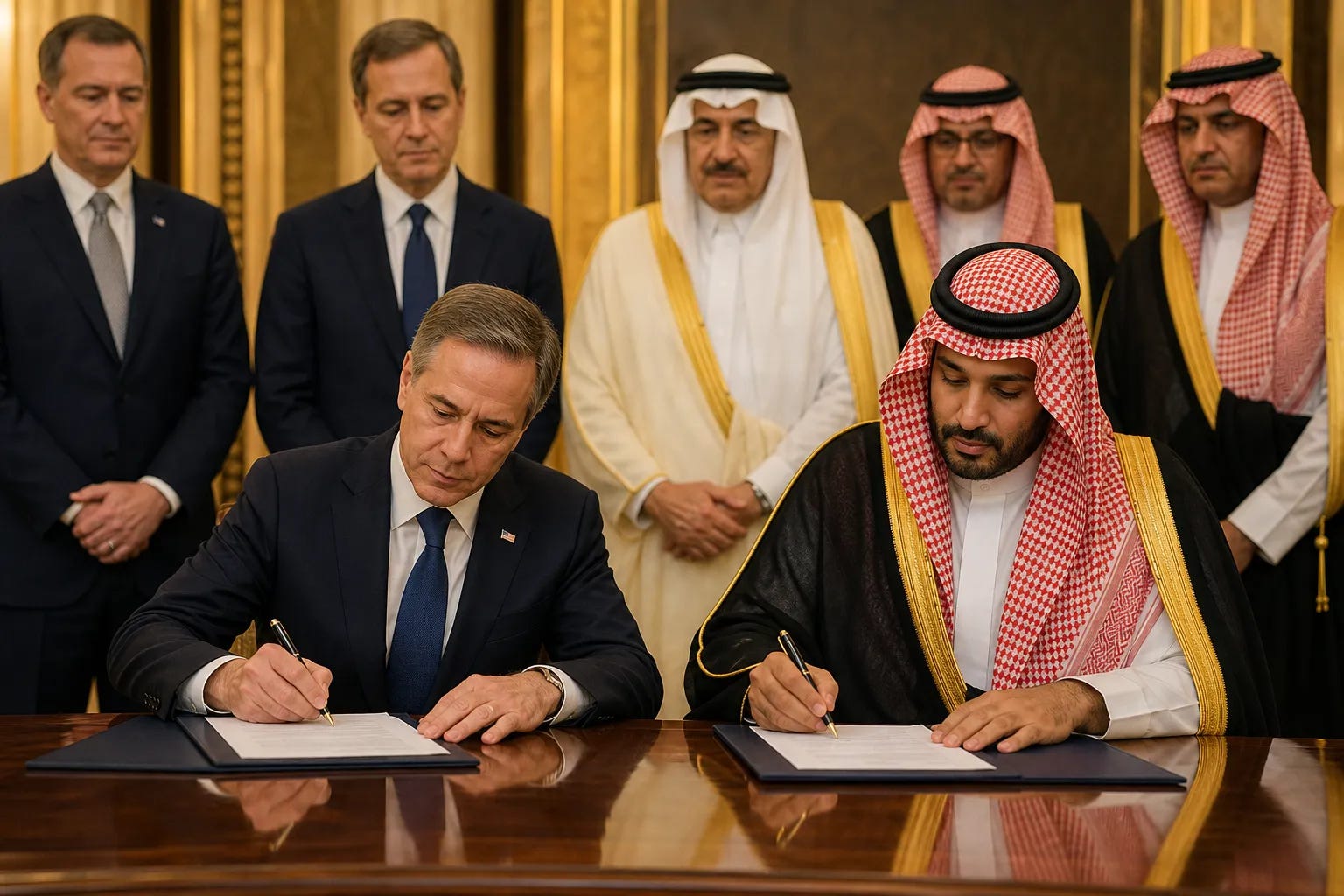
On Wednesday 22 July, in Washington, Energy Secretary Chris Wright and Saudi Energy Minister Prince Abdulaziz bin Salman signed a civil nuclear cooperation agreement alongside a bilateral safeguards arrangement. The full text has not been published. Neither have the two confidential letters that accompany it. Two weeks later the agreement has still not been transmitted to Congress, which means the review clock has not started.
The agreement does not authorise Saudi Arabia to enrich uranium. It writes a legal path that could one day allow it. The distance between those two statements is the subject of this piece.
For half a century the United States organised part of the international order through rules that reached well beyond military alliances, and civil nuclear energy belonged to that architecture. The Non-Proliferation Treaty set the legal frame; Washington built a further layer on top of it through bilateral cooperation agreements, trading access to American technology, fuel and industrial support for increasingly tight conditions on the sensitive end of the fuel cycle. From this Washington derived the ambition of an American non-proliferation regime running parallel to the multilateral system. As we will see, that ambition never became a rule applied with any consistency, and the gap between the declared norm and the actual practice is precisely what is now surfacing.
Riyadh
In 2009 the United States and the United Arab Emirates signed the agreement that entered the vocabulary as the Gold Standard. Abu Dhabi voluntarily renounced both uranium enrichment and the reprocessing of spent fuel — the two activities that produce fissile material — and accepted the IAEA Additional Protocol, the instrument that permits inspections at undeclared sites. In exchange Washington opened the Emirati nuclear market to American firms. The Barakah plant, the Arab world’s first commercial nuclear station, was built by a Korean consortium under a twenty-billion-dollar contract: the 2009 agreement defined the legal framework of cooperation, not the tender.
What is rarely said is what happened next. After 2009 only one further agreement, with Taiwan in 2013, contained equivalent provisions. Vietnam in 2014 and South Korea in 2015 did without. The Gold Standard was announced as the new American norm at the very end of the Bush administration and applied, in the seventeen years since, exactly twice.
Saudi Arabia had at one point been willing to work within it. A non-binding memorandum signed under Bush in 2008 recorded Riyadh’s intention to import fuel rather than pursue sensitive technologies. That position hardened as Vision 2030 took shape. The kingdom has no nuclear plants and in 2023 generated its electricity almost entirely from gas and oil; the nuclear programme was meant to free hydrocarbons for export, meet domestic demand and develop national mineral resources. Renouncing enrichment in advance meant conceding that the most profitable and technologically advanced segment of the chain would remain abroad.
The strategic argument arrived alongside the industrial one. Through the years in which Iran accumulated expertise, centrifuges and stockpiles of enriched uranium, Saudi officials argued that a stable regional balance could not rest on permanent asymmetry. Mohammed bin Salman said publicly on 60 Minutes in 2018 that the kingdom would develop a weapon if Tehran did. That was widely read as a threat. It was better understood as a negotiating message addressed to Washington: Riyadh would no longer accept conditions stricter than those tolerated for Iran.
The Biden administration tried to fold the nuclear file into Saudi-Israeli normalisation. Riyadh discussed the package without moving on the nuclear question, and the Hamas attack of 7 October 2023 froze the diplomacy without resolving the problem underneath it. Energy Secretary Wright confirmed in April 2025 that talks had resumed and that a pathway to enrichment appeared possible, though the details were unsettled. By February of this year, according to documents seen by Reuters, the guardrails were already coming off.
By then Riyadh had options. Chinese firms had deepened their industrial and energy presence, and Beijing’s mediation of the Saudi-Iranian rapprochement in 2023 demonstrated political capital as well as commercial reach. More consequentially, the mutual defence pact signed with Pakistan in 2025 offered something Beijing cannot: not a reactor vendor but an umbrella. Pakistan’s defence minister said afterwards that his country’s nuclear programme would be available to the kingdom if required. The American debate has framed the alternative to Washington as Chinese competition. The real alternative was never commercial.
Jerusalem
Israel learned the shape of the agreement from the American press, through the reporting of the Wall Street Journal and the New York Times. On a file that has underpinned the entire regional security architecture since 1969, the principal ally was not consulted.
That year Richard Nixon and Golda Meir reached the understanding that has governed everything since: Israel would maintain nuclear ambiguity, avoiding tests and official declarations, and the United States would refrain from public pressure on the programme while sustaining its strategic support. The arrangement served both. Israel kept a credible deterrent without the diplomatic consequences of acknowledgement; Washington preserved a political distinction between the Israeli case and its global non-proliferation strategy. Ambiguity turned an exception into something manageable and stopped it becoming a formally recognised precedent.
Over time that choice interlocked with a second principle, the Qualitative Military Edge — the commitment, honoured by every administration of both parties, to Israeli technological and military superiority over regional rivals. Nuclear deterrence sat at the top of that structure; American conventional support was its foundation.
November 2025 had already moved both. At the White House, Washington and Riyadh signed a Joint Declaration concluding the negotiations on civil nuclear cooperation, establishing the legal basis of the partnership and confirming American companies as the kingdom’s partners of choice. In the same session Trump and Mohammed bin Salman signed the U.S.-Saudi Strategic Defense Agreement, accompanied by a defence package that includes future F-35 deliveries. The fifth-generation fighter is the asset against which the Israeli qualitative edge has been measured for a decade. Its promise to Riyadh touches the conventional foundation of the American guarantee in the same season in which the nuclear pathway touches the atomic one.
The July text introduces its variable procedurally. It does not authorise the immediate transfer of enrichment or reprocessing technology; it opens a legal route that could permit it later, and assigns to a two-year joint study the question of whether a Saudi fuel-production facility is necessary and commercially viable. Any such plant would be American-built, without transfer of the sensitive technology, and reporting indicates the kingdom is barred for a decade from developing enrichment technology itself or acquiring it elsewhere. Washington also chose not to require the Additional Protocol.
Analysis like this takes time, reading, and fact-checking. If you find it valuable, a donation helps keep this work independent. Thank you for supporting it.
That last choice was not merely permissive. Section 1264 of the FY2020 National Defense Authorization Act normally prevents the executive from submitting the Nuclear Proliferation Assessment Statement required for congressional review of a 123 agreement with a country that has not accepted enhanced international safeguards — a description that fits Saudi Arabia. The administration waived that restriction. Published excerpts of the waiver report state that the agreement would operate through a bilateral safeguards arrangement employing additional measures with IAEA involvement. The White House did not simply decline to ask for the Additional Protocol. It had to suspend a statute that stood in the way of proceeding without one.
Israeli politics fractured along predictable lines. Netanyahu declined to contest the agreement publicly, confining himself to Trump’s condition that implementation depends on Saudi accession to the Abraham Accords and recognition of Israel. The opposition, three months from the 27 October election, described an American strategic retreat and the opening of a regional proliferation season.
The prime minister’s reticence follows from that condition. Trump reintroduced Jerusalem into the equation in a position that admits no negotiation: Israel does not discuss the technical clauses, it receives a political condition that reopens normalisation with Riyadh and that Saudi demands on the Palestinian question make hard to satisfy. The government gains leverage and loses control of the file in the same motion.
The contrast with the Iran campaign completes the picture. Since 28 February the United States and Israel have conducted a joint military operation whose declared purpose is to reduce Iranian enrichment to zero. While that campaign continued, Washington wrote for Riyadh a path that could lead to exactly that enrichment. The hierarchy of American priorities has shifted while the underlying objectives have not. The July agreement does not formally alter the Israeli exception of 1969. It reduces its exclusivity. For half a century Israeli nuclear ambiguity coexisted with an American policy that tightly restricted access to sensitive technology. The Saudi path introduces a different logic: the Israeli exception survives, but it is no longer by itself the point around which Washington organises its regional strategy.
Washington
Great-power competition has changed where non-proliferation sits in American strategy. For fifty years Washington could treat nuclear cooperation as an instrument for consolidating alliances without straining the rules it had itself written, because for any country seeking a civil programme inside the Western system the United States was the near-obligatory partner. China’s emergence as a technological and financial competitor, and Russia’s persistence as a builder and operator of reactors across four continents, have narrowed that space. The United States still offers the most advanced technology and the most credible security guarantees. It is no longer the only option.
The doctrinal revision that meets this moment is most closely associated with Elbridge Colby, now Under Secretary of Defense for Policy. His reasoning is older than the office: he set it out in the National Interest in February 2014, in an exchange with David Santoro and with reference to Japan and South Korea, long before the Middle East became its testing ground. The premise is that the United States has exhausted the freedom of action of the unipolar period and must therefore rank vital interests above merely important ones, with competition with China in the Indo-Pacific at the top and everything else assessed by its contribution to sustaining that contest.
Colby has not commented publicly on the Saudi file, but his framework applies to it almost without friction. Faced with the prospect of Chinese participation in the Saudi programme, strengthening an ally’s position becomes an option to weigh pragmatically within an altered strategic frame. The stated objective remains preventing military proliferation; what changes are the instruments through which Washington believes it can pursue that without damaging its alliance system. The consistency between what was written in 2014 and what was signed in 2026 matters more than any statement.
The reversal is visible elsewhere too. Marco Rubio, as a senator, co-sponsored bipartisan legislation requiring that any Saudi nuclear agreement meet the gold standard and secure an affirmative congressional vote. In March, members of Congress wrote to him as Secretary of State reminding him of that record and urging him to return to it.
There is an irony in the mechanism itself, which the Stimson Center has noted: the Section 123 framework now being used to approve cooperation with Riyadh was created by the Nuclear Non-Proliferation Act of 1978, itself a response to India’s 1974 test. The instrument built to tighten controls on nuclear transfers is the instrument through which this transfer proceeds.
Which leaves the state of play tonight. The agreement is signed. The text is not public. The statutory obstacle has already been waived. The two accompanying letters remain confidential, and Democrats on the relevant committees have said they will seek to read them before the review begins. The Energy Department has said the agreement will be transmitted to Congress; as of this writing it has not been. When it is, the Atomic Energy Act provides for review across two periods totalling ninety days of continuous session — a measure that, with the recess and the midterm calendar, could run well into next year. A joint resolution of disapproval would need a veto-proof majority to bind.
For half a century Washington claimed the right to define access to the most sensitive nuclear technologies without ever applying that claim consistently. What is ending is not a consolidated regime but the fiction of a standard that was already an exception. The difference is that the earlier departures were technical and concerned countries far from the centre of competition, while this one applies to the principal Arab partner of the United States, in a region where enrichment is the object of a war now under way.
A longer version of this analysis appeared yesterday in Italian, as Un mondo di eccezioni, in Linea di faglia. The two newsletters read the same events from opposite shores of the Atlantic.